The A4 Corridor Project in Bristol
Late in August 2023, the West of England Combined Authority (WECA) launched its long awaiting consultation on proposed changes to the A4 road that runs right through the heart of Brislington.
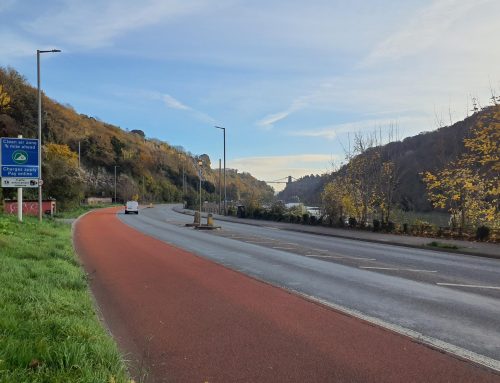
The ‘A4 corridor project’, as it is known, has been on the back-burner for several years now. When I first became a councillor in January 2020, I had a meeting with senior transport officers within Bristol City Council to find out exactly what the plans were for this area. I was told that the council had ruled out previous ideas to turn the old Brislington railway path into a relief road, and instead were concentrating on ways to make use of it for public transport and active travel (walking and cycling).
In April 2022 WECA received confirmation of a grant from government totalling £540 million, to cover the period April 2022 – March 2027. This grant is for investment in local transport networks in the West of England region. One of the proposals put forward as part of the grant application was for major work to be carried out to improve bus, cycling and walking journeys along the entire A4 corridor from Bath to Bristol.
The funding comes with guidelines: schemes must drive growth through infrastructure investment, level up services towards the standards of the best, and promote modal shift from cars to public transport, walking and cycling). They must reduce carbon emissions and pollution from transport -aligned with the UK’s legal commitments. They must further the objectives of the national bus and cycling strategies, which includes ambitious bus and cycling priority measures, with decisions on Key Route Networks led by Metro Mayors. Schemes should promote the use of active travel and public transport; not lead to overall increases in car use or car modal share; tackle traffic congestion; and improve air quality.
This last paragraph is essential in helping us to make decisions about WECA’s proposals as it gives us something to judge them by.
The Proposals
Back in late 2021, local councillors were shown details of several proposals for changes to the area drawn up by Bristol City Council staff, in advance of any agreed funding being awarded. These proposals, we were told, had been whittled down from a long list of 80 or so. It has to be said that I was underwhelmed by what we were shown at that time, as I did not think they would achieve anything like the benefits we need to see from such massive change – but importantly, none of them included a proposal to convert the old railway line between the two major supermarkets, Tesco and Sainsburys, into a major road. Equally importantly, the Mayor of Bristol Marvin Reese and his staff agreed with me, and officers were told to think again.
With the funding being allocated in 2022, the project was handed over in its entirety to WECA, who have had 18 months to look at them again and to come up with new proposals. Sadly, not only have they not come up with anything new, but rather they have resurrected something very old instead.
The two main proposals on the table from WECA are:
- Use the old railway path between Tesco and the A4 as a diversionary route for traffic, instead of sending it up the Callington Road. Car traffic would then continue along the A4 as normal, but buses (and cycles) would be diverted onto the old railway path between the A4 and Sandy Park, before rejoining the A4 at Arnos Vale. Cars would still be able to use the A4 for local access, however.
- Use the old railway line between Tesco and Sainsburys as a new road, diverting all traffic off the A4, which would become a bus-only route between the junctions with West Town Lane in the South East and the A37 at Three Lamps in the North West.
There is more to it than this of course – you can read the full proposals here:
https://b2b.haveyoursaywest.co.uk/index.php?contentid=31
So what do I think?
The consultation talks about ‘bringing positive benefits, but downsides too – and big choices to make along the way.’ Personally, I think this is a massive ‘miss’ for the Combined Authority, and I would urge people to object strongly to the proposals, especially the one to build a road all the way to Sainsburys.
At a recent Webinar to discuss the proposals – held, incidentally, a week after they were launched, my first questions to WECA staff were these:
- What percentage of modal shift away from car travel to more sustainable forms of travel do you think this will achieve?
- How much improvement to bus journey times will these proposals result in?
Officers were unable to answer either question, only saying that such detail would come at a later stage. I was shocked, frankly. How can you ask people to give their opinions when you can’t give them any idea of how these proposals will improve their lives or achieve the kind of changes that our city is crying out for?
I then asked them whether they had any targets for the project – they surely must have these. I was told that they did not have them to hand, but could be produced at a later date. Again, pretty shocking for a project on this scale. I have now received the WECA targets for the project, and here they are:
- Provide the infrastructure required to contribute towards achieving 95% of services running on time, defined as being no more than 1 minute early or 5 minutes late, by 2030
- Provide the infrastructure required to contribute towards achieving a 10% end to end (between Three Lamps Bristol and Bath City Centre) bus journey time reduction by 2030
- To enable continuous, safe and legible active travel journeys end-to-end and to the corridor for those living and working along the corridor.
Again, my italics. To me, these targets are not strong enough for the challenges we face as a city, and they do not meet one of the main criteria set out in the funding agreement – promote modal shift from cars to public transport, walking and cycling.
We need to know a few things before we can make an informed choice;
- How many people do we think will get out of their cars and use public transport if bus journey times between Bristol and Bath are improved by 10%? (Modal shift between cars and buses is typically very low)
- What kind of improvement would a 95% on-time service represent? (in other words, what percentage of buses on this corridor currently run on time?)
- Would building a new road lead to (remember this?) an overall increase in car use or car modal share? (there are many who think it would – see below)
- Would building a new road solve Bristol’s traffic congestion and air quality issues, or simply move them elsewhere – for example to Old Market, Feeder Road, Callington Road, West Town Lane and many of our other roads already plagued by rat-running (Broomhill Road, Hungerford Road, Newbridge Road for example).
Regarding whether road building increases car use, rather than cuts it, here is an article from Greenpeace in 2020 which is well worth the read:
https://www.greenpeace.org.uk/news/building-new-roads-just-creates-more-traffic-heres-the-proof/
So What Do You Suggest?
There are a number of proposals being put forward by different groups within the city to help solve Bristol’s transport problems, and from the Mayor’s office too. They all have one thing in common – mass or rapid transit. To most people this means trams, of one kind or another.
The reason people are so keen to re-introduce trams to our city is that they typically achieve much greater modal shift than buses ever will. As David Andrews of Bath Trams puts it:
Buses have to operate for economic reasons at long service intervals, in order to “save up ” enough passengers at the bus stop to make each trip worthwhile. They also have to cram in as many passengers as possible which is why they have bench seats close together. Both these factors make them unattractive to motorists, who rarely switch to buses from their cars.
Due to entirely different cost structures, trams can operate much more frequently than buses and have much more spacious, less crowded seating, both of which are attractive to car drivers, so trams typically get a 30% switch from cars to trams, as opposed to zero from cars to buses.
Trams are quieter and smoother, but also quicker. Multiple doors mean that boarding times are only about 20 secs compared to 2 minutes for a busy double-decker bus.
So why are we looking to spend millions of pounds making driving more difficult, without providing an alternative solution that people will actually be willing to switch to?
One alternative idea, mooted by the Transport for Greater Bristol pressure group, but one which I know also happens to be supported by the Leader of the Labour Group of Councillors, is to run rapid-transport from Temple Meads along the Feeder Road to Avonmeads shopping centre (a vast, untapped public transport audience), and then to bring it along the old railway path to the A4 and run it alongside the existing road as far as possible. With all the plans for new housing at the Brislington Park and Ride, this would make a huge amount of sense. You could also split the line at Callington Road and run up the Airport Road all the way through Hengrove and out to the airport.
Blue sky thinking? Maybe, but not black-sky thinking like building a new road. Surely it is these kind of radical ideas we need if we are to service a growing city with decent public transport and reduce the car-dependency of many or our residents.
Tim Rippington