The Bath Road Gates of Arnos Vale Cemetery is in Need of Restoration
Arnos Vale Cemetery forged nearly two centuries ago, have endured through revolutions in industry, the changing generations of Bristolians, and the rise and fall of the Victorian burial movement.
Yet, despite their rich history and architectural significance, these gates now stand in urgent need of restoration.
A Vision of Victorian Grandeur
Conceived in the 1830s, Arnos Vale Cemetery was intended to be Bristol’s answer to the great landscaped cemeteries of Europe. Drawing inspiration from Greek necropolises, the cemetery was designed as a serene space of remembrance, complete with terraced hillsides, gardens planted with mythological trees, and neo-classical lodges flanking the entrance. The landscape itself was designed to evoke reflection and contemplation.
At the heart of this grand design stood the Bath Road gates – not just a practical entrance, but a statement of Victorian ambition and artistic achievement.
Crafted by Local Hands
These gates were no ordinary ironwork. Commissioned by the cemetery’s architect, Charles Underwood, they were intended to be a dignified and striking gateway to the site. While no surviving plans confirm Underwood’s involvement in the detailed design of the gates themselves, his influence is evident in the overall vision for the cemetery’s entrance.
The gates were brought to life over several years, between 1839 and 1845, through the work of local artisans. Ledgers from the Bristol General Cemetery Company reveal that several Bristol-based workshops contributed to the gates’ creation. Iron manufacturers Messrs. Room, Grazebrook & Co. crafted the gates’ metalwork, while Sperrings & Bennett supplied the posts. Construction firm Sweat & Bryant, under the supervision of Underwood, handled the construction of the gates and their surroundings. Local carpenter Daniel Farmer worked on the timber components, while mason Godwin was responsible for the stonework. The finishing touches were applied by Richard Edward Aston, a Brislington-based painter, who painted the ironwork and railings.
Together, these tradespeople formed the backbone of an architectural masterpiece that still welcomes visitors to the cemetery today.
A Symbol of Struggle and Survival
In 1966, the Bath Road gates, along with the adjoining lodges, were granted Grade II* listed status, cementing their place as a national treasure. The gates’ ingenious sliding mechanism, spear-headed railings, and cobbled tracks all reflect the technical sophistication of early Victorian engineering.
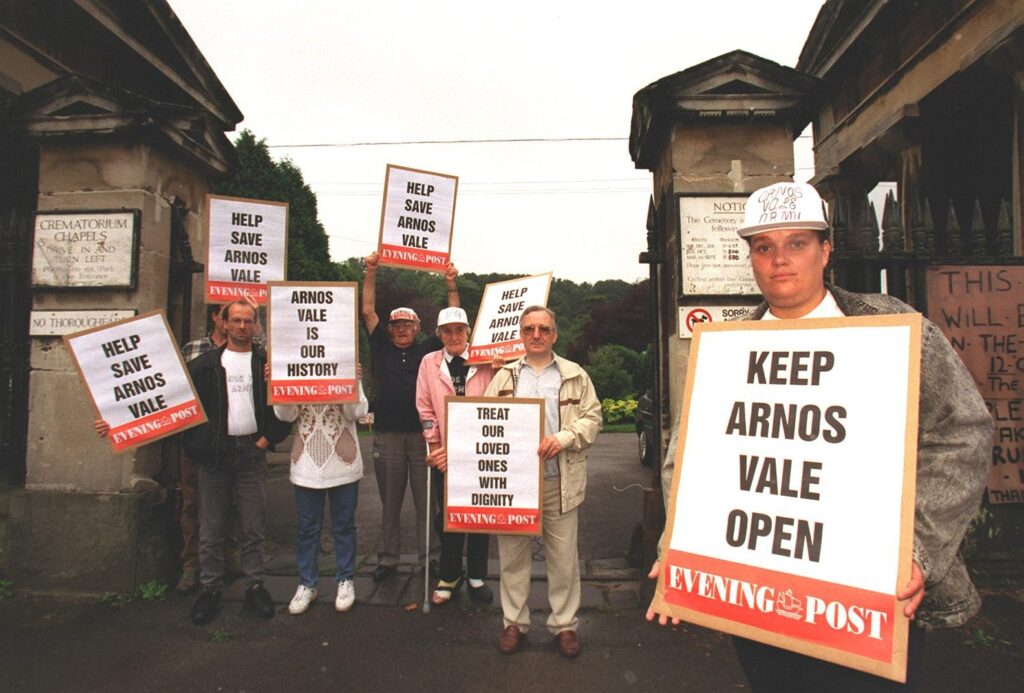
However, by the late 20th century, Arnos Vale Cemetery found itself at a crossroads. The site was full, its crematorium licence revoked, and in 1998, a private owner announced plans to close the gates, with redevelopment on the horizon. This sparked a wave of local outrage, as residents feared losing access to the historic site. In a remarkable act of community defiance, local people took it upon themselves to manually open and close the gates each day, ensuring the cemetery remained accessible. Their collective action led to a successful campaign that resulted in the council’s compulsory purchase of the cemetery and the establishment of a charitable trust to manage the site.
Preserving a Heritage for Future Generations
Today, the Bath Road gates still serve their dual purpose: they act as a dramatic entrance to the cemetery, welcoming visitors into a space rich with heritage, art, and history. But they also stand as a barrier, protecting the cemetery’s fragile monuments from theft and vandalism.
However, time has taken its toll on these historic gates. The ironwork is in need of specialist restoration, the stone piers require repair, and the sliding mechanism needs to be renewed to ensure the gates continue to function safely.
Restoring the gates is not simply about maintenance; it is about preserving a significant part of Bristol’s history. The gates are a testament to the Victorian era’s ambition and craftsmanship, to the local community’s fight to save a beloved landmark, and to the enduring power of place.
By supporting the fundraising appeal for their restoration, the public can help secure the gates’ future and ensure that they continue to protect and welcome visitors to Arnos Vale Cemetery for generations to come. Perhaps even more remarkably, this restoration could uncover new stories – from descendants of the craftsmen who worked on the gates, or from forgotten materials left behind – adding yet another layer to the fascinating history of this iconic entrance.
The Bath Road gates of Arnos Vale are more than just a structure. They are a symbol of Bristol’s past, a piece of local craftsmanship, and a reminder of the community’s ability to protect its heritage. Their restoration is an opportunity to safeguard this legacy for the future, ensuring that the gates continue to stand as a powerful entrance to the stories of Bristol’s past.
See the latest Bristol news today at https://directlocalbristol.co.uk/bristol-news/